


Quick Summary
This guide examines the unique challenges of coastal landscaping, specifically addressing the destructive force of salt spray and soil salinity. We outline a strategic “Zonal Design” approach for luxury estates, categorizing properties into exposure zones. The article provides specific plant palettes for Martha’s Vineyard and Florida, debunks common myths about storm preparation (such as “hurricane pruning”), and details remediation protocols for post-storm soil health.
Owning a luxury property on the water, whether it’s the rugged dunes of Martha’s Vineyard or the barrier islands of Florida, requires more than just an eye for beauty; it requires an understanding of environmental physics. The primary threat to your landscape is salt. It arrives as aerosol spray, coating leaves and causing chemical burns, and it accumulates in the soil, creating “physiological drought” where roots cannot absorb water even when the ground is wet.
To maintain the high standards of Estate Care, we employ a “Zonal Design” strategy. This approach acknowledges that a coastal property is not a monolith but a series of microclimates, each requiring specific salt-tolerant landscaping ideas to thrive.
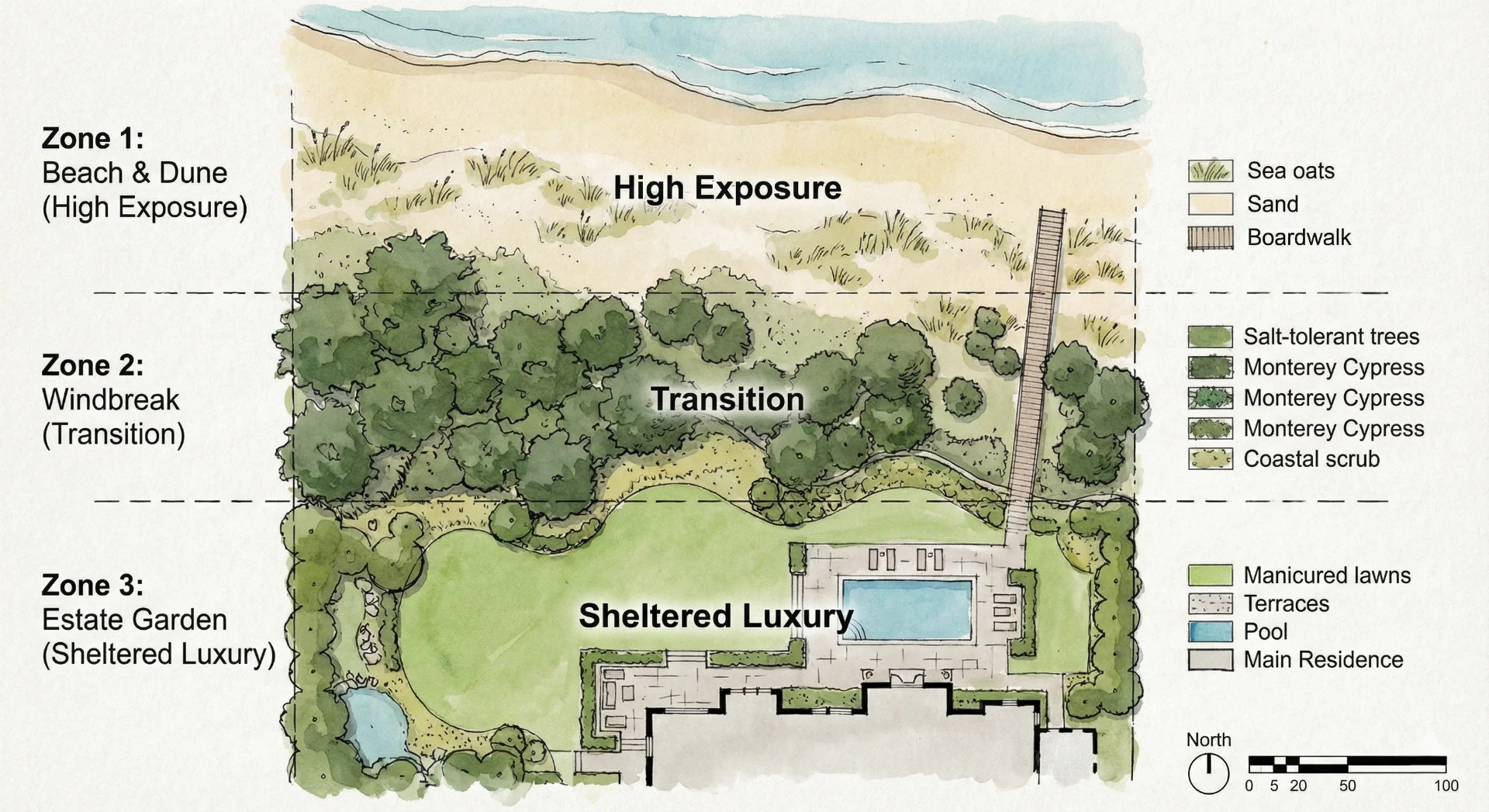
Zone 1: The Frontal Dune (High Exposure)
This is the first line of defense. Plants here face direct salt spray, shifting sands, and high winds. The goal in this zone is structural engineering, using roots to bind the sand and prevent erosion.
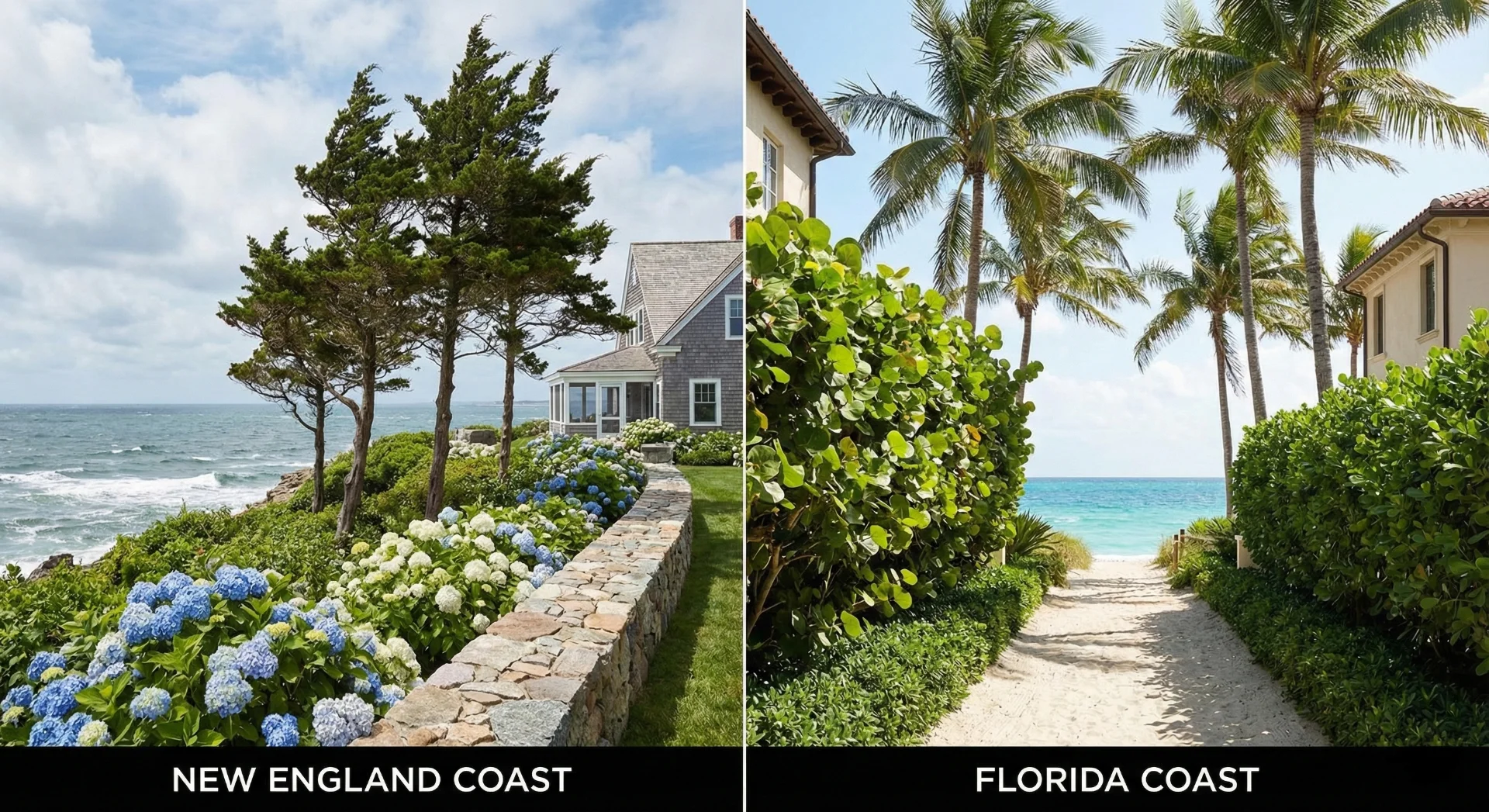
- Martha’s Vineyard Strategy: We utilize American Beachgrass (Ammophila breviligulata) as the keystone species for stabilization. For aesthetic texture, we integrate Rugosa Rose (Rosa rugosa) and Beach Plum, which offer the classic New England visual of weathered resilience.
- Florida Strategy: In the subtropics, Sea Oats (Uniola paniculata) are the gold standard and are often legally protected due to their importance in dune preservation. We pair these with groundcovers like Railroad Vine, which can withstand full saltwater immersion during high tides.
Zone 2: The Maritime Transition (The Buffer)
Set back from the primary dune, this zone acts as a living filter. By establishing a vegetative buffer here, we protect the more delicate ornamental plants closer to the residence.
- Martha’s Vineyard Strategy: Eastern Red Cedar (Juniperus virginiana) is essential here. These hardy evergreens form dense screens that physically block salt spray. Northern Bayberry is another excellent choice, as it fixes its own nitrogen in poor soils.
- Florida Strategy: We often deploy Seagrape (Coccoloba uvifera) in this zone. Its large, round leaves are highly resistant to wind and salt. Cabbage Palms and Saw Palmetto provide vertical structure and privacy without blocking the ocean breeze.
Zone 3: The Sheltered Estate Garden
Behind the protection of the transition zone, we can implement more ornamental salt tolerant landscaping ideas. However, soil salinity remains a factor.
In both regions, we recommend raised beds with imported topsoil for sensitive species. For estates in Florida, species like the Green Island Ficus or various salt-tolerant Hibiscus varieties provide lush greenery without the constant risk of chlorosis (yellowing) found in less adapted plants. In New England, this protected zone is where your hydrangeas and high-maintenance turf can thrive, shielded from the harsh sea spray.
Storm Resilience and Recovery
True luxury is peace of mind during a storm. Whether it is a Nor’easter or a Hurricane, your landscape design determines how quickly your property recovers.
The Myth of “Hurricane Pruning”
A common mistake in Florida is “Hurricane Pruning” of palms, removing all but the top few fronds. This is harmful. It weakens the tree’s ability to photosynthesize and actually increases the risk of the palm snapping in high winds. Palms are naturally aerodynamic; they should be left full.
Post-Storm Soil Remediation
If your property suffers a storm surge, the soil will be saturated with sodium. The immediate Estate Care protocol involves flushing the soil with fresh water to leach out the salts. We also apply Gypsum (Calcium Sulfate), which chemically displaces sodium from soil particles, preventing long-term damage to the soil structure.
By selecting the right genetics and designing with nature rather than against it, your estate can remain a sanctuary of green against the blue of the ocean.
Contact our design team today to audit your property for coastal resilience.
Frequently Asked Questions
What are the best salt tolerant landscaping ideas for coastal estates?
The best approach is “Zonal Design.” Use highly tolerant plants like Sea Oats or American Beachgrass on the dunes (Zone 1) to block spray. Use wind-resistant trees like Eastern Red Cedar or Seagrape in the transition area (Zone 2) to protect more ornamental gardens near the house (Zone 3).
How do I protect my lawn from salt spray?
The most effective method is to rinse the foliage with fresh water immediately after a storm or period of high wind. This washes the salt off the leaf blades before it causes chemical burns. Additionally, maintain deep, infrequent irrigation to flush salts down past the root zone.
Should I prune my palms before a hurricane?
No. “Hurricane pruning” (removing most fronds) is a myth. It stresses the tree and can make the trunk more brittle. Palms are naturally adapted to shed fronds if necessary; removing green fronds reduces the tree’s energy reserves and stability.
What can I do if my garden was flooded by saltwater?
Immediate action is required to prevent root death. You must flush the soil with generous amounts of fresh water to leach the salt away. Applying Gypsum (Calcium Sulfate) is also highly effective, as the calcium replaces the sodium in the soil, helping to restore soil structure.
Which trees are most resistant to high winds in Florida?
Native trees are generally superior for storm resilience. The Live Oak (Quercus virginiana) has incredibly dense wood and a low center of gravity, making it one of the most wind-resistant trees available. Conversely, exotic trees like the Queen Palm are brittle and prone to snapping.

