

Spring Lawn Care on Martha’s Vineyard: The Complete Homeowner’s Checklist
TL;DR: Spring lawn care on Martha’s Vineyard follows different rules than the mainland. Your sandy coastal soil loses nutrients fast, salt air damages turf through winter, and fertilizing too early is one of the most common mistakes we see. This checklist walks you through every step, from the first soil temperature check to your pre-summer mow, so your lawn is thriving before Memorial Day weekend. Start when the soil hits 50°F, not when the calendar tells you to.
Every spring, we see the same pattern across Martha’s Vineyard. A warm week arrives in early April, homeowners rush out to rake, fertilize, and mow, and by June their lawns are thin, patchy, and struggling. Spring lawn care on Martha’s Vineyard isn’t just about timing. It’s about understanding what this island does to turf over a long winter and responding to those specific conditions with the right plan.
The sandy, salt-exposed soil from Edgartown to Aquinnah behaves differently from the loam-heavy lawns you’ll find on the mainland. Nutrients leach faster. Salt damage appears in places you don’t expect. The narrow window between mud season and summer heat stress leaves little room for error. Getting it right means working in the correct order, at the correct time, with an approach built for the Vineyard’s coastal environment.
We manage spring programs for 50+ properties across all six Vineyard towns. Here’s exactly what that process looks like, step by step.

When Should You Actually Start Spring Lawn Care on Martha’s Vineyard?
The right time to start spring lawn care on Martha’s Vineyard is when your soil temperature consistently reaches 50°F, not when the first warm days appear on the forecast. Soil temperature is the only reliable trigger for spring lawn activity. Cool-season grasses, which are standard across the Vineyard, don’t begin meaningful root growth until soil reaches 50°F. Fertilizing or seeding before that threshold means nutrients flush past the root zone before your grass can use them.
Soil temperature lags air temperature by about two to three weeks. That 65°F afternoon in late March doesn’t mean the ground is ready. Across coastal New England, consistent 50°F soil temps typically arrive in early to mid-April depending on the year. You can track your reading through the UMass Extension soil temperature maps, which are updated regularly through the growing season.
Wait for the signal. Every step on this checklist works better when you time it right.
Start Here: Walk the Full Property Before You Do Anything Else
Before you rake, fertilize, or start the mower, walk every section of your lawn and document what winter actually left behind. This step gets skipped constantly, and it’s the one that matters most.
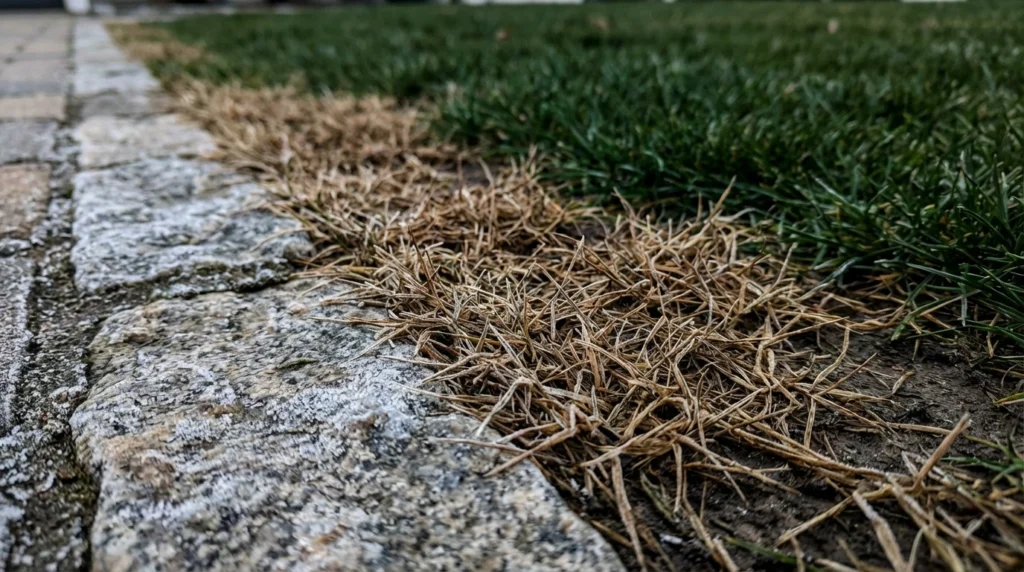
Look for brown, straw-like patches near driveways, walkways, and coastal-facing edges of the property. These usually indicate salt damage, and they need a different response than dormant grass. Look for circular, gray-white areas with a matted, flattened texture: that’s snow mold, a fungal disease that spreads under snow cover and becomes visible once the melt begins. Knowing which problem you’re dealing with before you act is what separates a real recovery plan from a guessing game.
Where you’re located on the island shapes what you’ll find. Lawn care in Edgartown and Oak Bluffs near the water means more concentrated salt exposure along coastal edges. Up-island properties in West Tisbury, Chilmark, and Aquinnah often deal with slower drainage and more moisture retention in shadier, sheltered spots. Walk the full perimeter, note what you find in each zone, and use that information to prioritize the steps ahead.
Does Sandy Soil Change How You Fertilize in Spring?
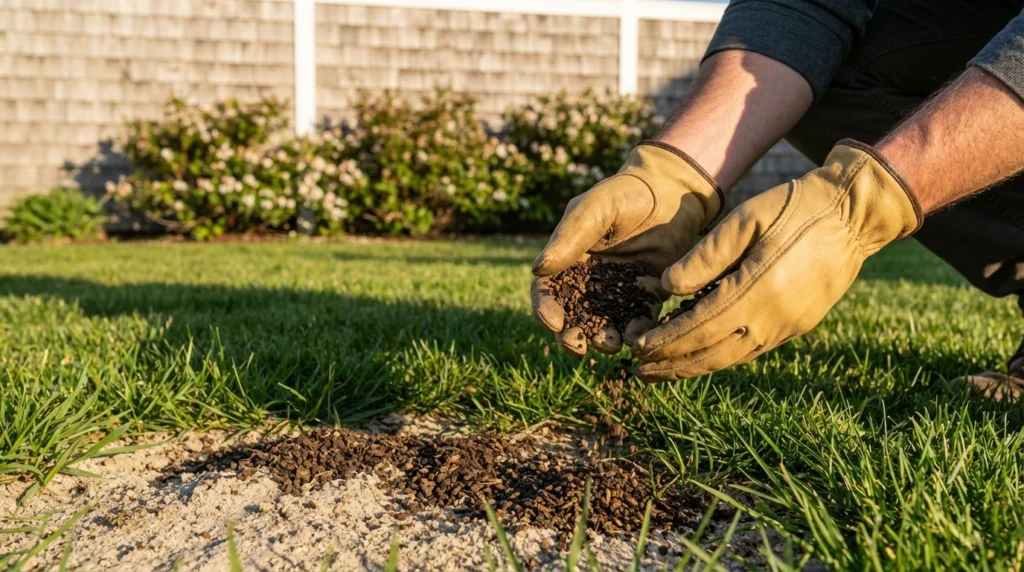
Yes, significantly. Martha’s Vineyard’s sandy coastal soil drains much faster than the loam-based soils common on the mainland, which means nutrients leach out of the root zone more quickly. Applying a standard fast-release synthetic fertilizer in early spring on Vineyard soil is one of the most expensive mistakes you can make. Sandy coastal soil requires slow-release organic fertilizers, applied at the right soil temperature and more frequently than a standard mainland schedule.
The timing benchmark for spring fertilizing on the Vineyard is 55 to 60°F soil temperature, not the date on the calendar. Fertilizers with at least 60% slow-release nitrogen stay in the root zone long enough for your grass to absorb them. Organic options like feather meal and compost-based blends are well-suited to island properties because they feed soil biology rather than just pushing surface blade growth.
We always recommend a soil test before any spring fertilization program. Sandy Vineyard soils tend to run acidic and low in phosphorus. Without a test, you’re guessing at the formula. A test gives you a precise, data-backed treatment plan for the season ahead. For a deeper look at building a fertilization approach designed for coastal conditions, the organic fertilization guide for coastal homes is worth reading before you start.
Should You Aerate in Spring or Fall on Martha’s Vineyard?
For most Martha’s Vineyard properties, fall is the better window for aeration and overseeding, not spring. The late August through October period gives cool-season grasses warm soil, reliable moisture, and time to establish strong roots before the first frost. Spring aeration makes sense in specific situations: if heavy equipment ran over wet ground during winter, if a section of the lawn receives constant foot traffic, or if visible compaction is causing water to pool and run off rather than absorb into the soil.
Sandy soil naturally resists compaction better than clay-heavy soils. Routine spring aeration on the Vineyard’s sandy lawns is rarely the right blanket recommendation. In most cases, a light raking to lift matted turf and improve airflow is all that’s needed in spring. Save aeration as a targeted response to a confirmed problem rather than a default seasonal task.
If bare patches from winter damage need filling, spring overseeding is appropriate once soil temps are consistently above 50°F. For cool-season varieties suited to coastal island conditions, tall fescue, fine fescue, and perennial ryegrass are the most reliable performers. They handle the island’s salt exposure and lower soil fertility better than most other species.
The Spring Mowing Rules Most Vineyard Homeowners Get Wrong
The first mow of the season sets the tone for the rest of the year. Most homeowners mow too early, too short, or both, and the lawn spends the next six weeks trying to recover instead of building the density it needs to carry through summer.
Wait until you see at least one inch of consistent new green growth across the entire lawn before the first cut. Cool-season grasses shouldn’t be mowed until they’ve fully broken dormancy, and cutting a lawn that’s still emerging from winter is one of the fastest ways to let weeds take over. Set your mower blade to 3 to 3.5 inches. Never remove more than one-third of the blade height in a single pass.
Avoid mowing on wet or soft ground. Spring soils across the Vineyard are often saturated well into April, and running equipment on wet turf compacts the soil and creates ruts that affect drainage for months. A precision mowing schedule timed to actual soil conditions, rather than a fixed weekly calendar, makes a visible difference by June.
How to Fix Salt Damage Before It Spreads
Salt-damaged lawn areas look brown and straw-like, appearing most often near roads, driveways, and coastal-facing property edges. In most cases, the soil still contains viable root structure. The damage is chemical, not permanent, and it responds well to a clear recovery process.
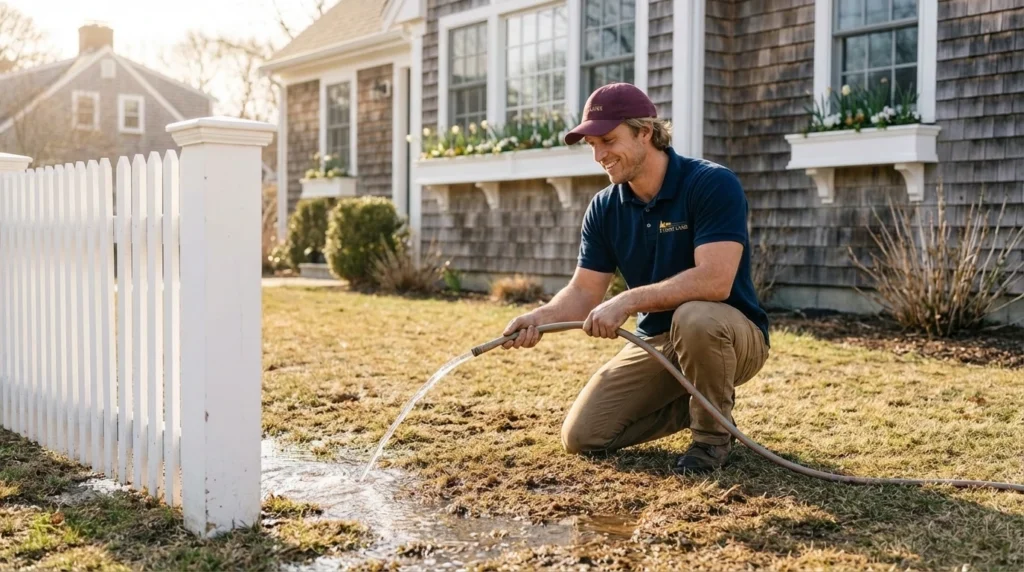
First, flush the affected areas. Use your irrigation system or a garden hose to thoroughly water the damaged zones over several sessions, pushing sodium ions down past the root zone rather than saturating the area all at once. After flushing, apply gypsum (calcium sulfate) at the rate listed on the product packaging. Gypsum displaces sodium ions and replaces them with calcium, restoring soil structure and improving how water moves through the ground.
Once the area is flushed and treated, overseed any bare or thinning patches when soil temps hold above 50°F. For properties near saltwater with repeated coastal exposure along the edge of the lawn, longer-term salt-tolerant landscaping choices for those border zones can reduce the salt damage you’re managing every spring. Those edges will always take more abuse than the rest of the property, and the planting strategy should reflect that reality.
When Is the Right Time to Call a Professional?
Spring lawn care is something many homeowners handle themselves, and for a well-maintained property in reasonable shape, that’s often the right call. But there are situations where the cost of getting it wrong clearly outweighs the cost of professional help.
Call in a specialist if your soil test reveals multiple deficiencies and you’re not sure how to address them in the right sequence. If snow mold or another fungal disease has spread beyond a small isolated patch, diagnosis and treatment require experience to get right the first time. If the property has gone without professional care for more than one full season, or if you’re managing from off-island and can’t physically monitor progress through spring, a coordinated program prevents the kind of compounding neglect that takes an entire growing season to correct.
We offer spring lawn care in Edgartown, Oak Bluffs, Vineyard Haven, West Tisbury, Chilmark, Aquinnah, and every property in between. If you’d rather hand this off and know it’s handled properly, reach out for a free spring consultation and we’ll build a plan around what your specific property actually needs.
Conclusion: Get Your Vineyard Lawn Ready Before Memorial Day
Spring lawn care on Martha’s Vineyard comes down to three things: the right timing, the right soil knowledge, and an honest look at what winter left behind. Start when your soil hits 50°F. Test before you fertilize. Walk the property before you touch a single piece of equipment.
The Vineyard’s sandy, salt-exposed conditions require a more careful and specific approach than most generic spring guides provide. That’s true whether you’re managing a year-round property in Vineyard Haven, preparing a vacation rental in Oak Bluffs for its first summer guests, or opening a seasonal estate in Chilmark for Memorial Day weekend.
Your lawn is part of what makes this island exceptional. It deserves attention that reflects that. If you want a professional set of eyes on your property this spring, request a free quote and we’ll take it from there.
Frequently Asked Questions
When is the best time to start spring lawn care on Martha’s Vineyard?
The best time to start is when soil temperatures consistently reach 50°F, which typically happens in early to mid-April on Martha’s Vineyard. Soil temperature is a more reliable signal than air temperature or the calendar date. Soil temp lags air temp by about two to three weeks, so that first warm April weekend doesn’t mean your lawn is ready. You can check local soil temperature readings through the UMass Extension resources updated throughout the growing season.
How do I know if my lawn has salt damage from winter?
Salt-damaged turf appears as brown, straw-like patches concentrated near driveways, walkways, roads, and any coastal-facing edges of your property. Unlike dormant grass, which greens up uniformly as temperatures rise, salt-damaged areas stay brown and brittle well into spring. The recovery process involves flushing the affected soil with water over several sessions, applying gypsum to restore soil structure, and overseeding bare spots once soil temps are consistently above 50°F.
Should I fertilize my Martha’s Vineyard lawn in early spring?
Not before soil temperatures reach 55 to 60°F consistently. Applying fertilizer too early on the island’s sandy soil means nutrients leach past the root zone before your grass can absorb them. When the timing is right, use a slow-release organic fertilizer with at least 60% slow-release nitrogen. A soil test beforehand tells you exactly what your lawn needs and prevents you from addressing the wrong deficiency and wasting money on the wrong inputs.
What grass types grow best on Martha’s Vineyard’s sandy coastal soil?
Tall fescue, fine fescue, and perennial ryegrass are the strongest performers for the island’s sandy, coastal conditions. Tall fescue offers good salt tolerance and deep root growth suited to well-draining soils. Fine fescue thrives in low-fertility sandy conditions and handles shadier spots well. Perennial ryegrass establishes quickly and works well for overseeding bare patches in spring. All three are cool-season grasses that perform best in spring and fall on Martha’s Vineyard.
Do I need to aerate my Martha’s Vineyard lawn every spring?
Not necessarily. Sandy soil resists compaction naturally, which means spring aeration isn’t a universal recommendation for Vineyard properties. Fall is typically the better aeration window for cool-season grasses in this region. Spring aeration makes sense only if heavy equipment ran over wet ground during winter, if an area shows visible water pooling and runoff, or if compaction is confirmed through observation. A light spring raking to lift matted turf is often all that’s needed for most island properties.
Related Articles.

Questions About Your Property?
Our team is always happy to talk through your specific situation - no commitment required.