
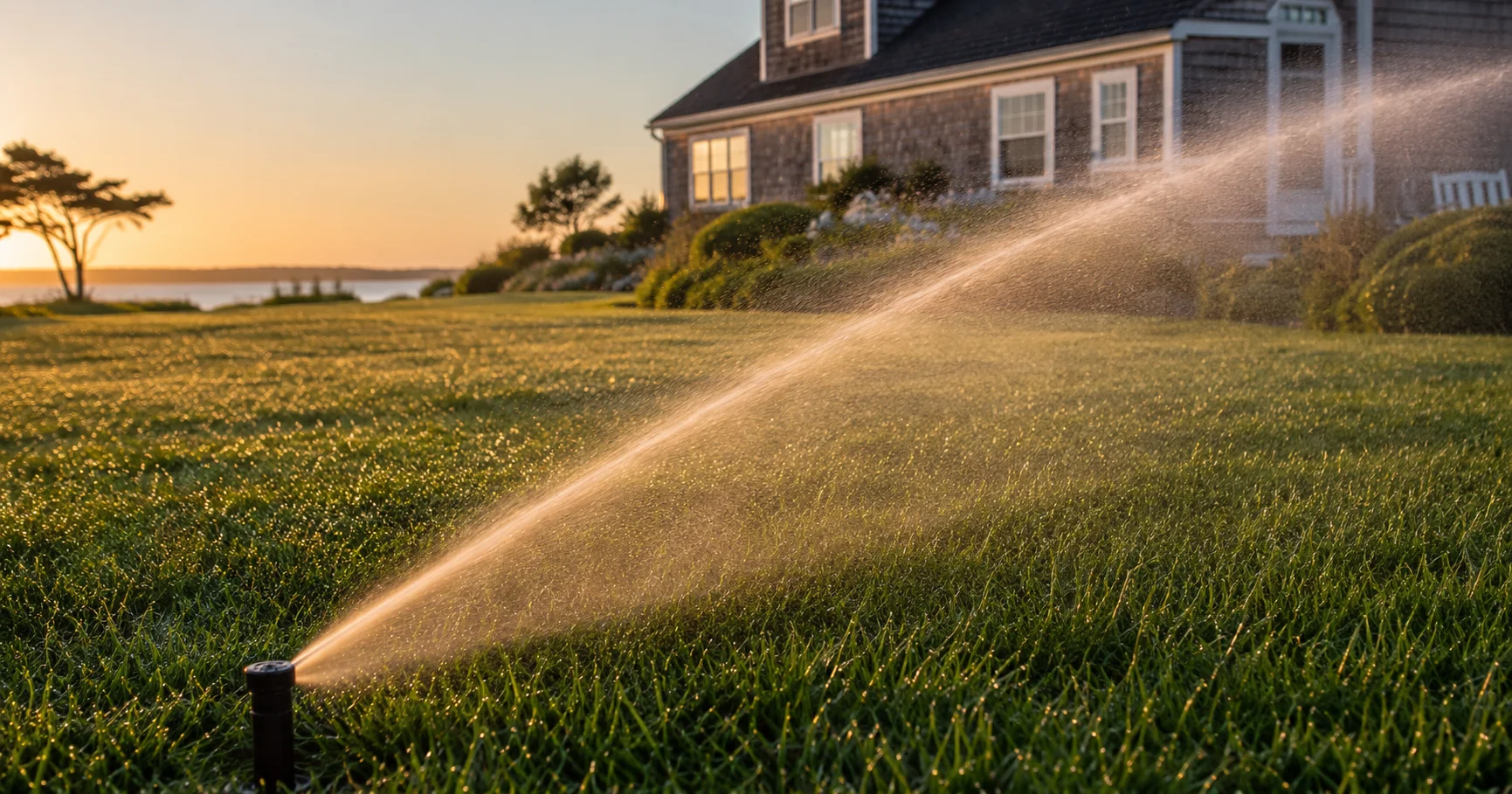
Smart Irrigation on Martha’s Vineyard: How to Water Less and Grow More
TL;DR: Martha’s Vineyard’s sandy soils drain fast, summer droughts are increasingly common, and the island’s coastal ponds can’t absorb more nutrient runoff. Smart irrigation systems water only what your lawn actually needs, using real-time soil moisture data or local weather readings to cut waste and protect the ecosystem you love. This guide explains how the technology works, why it matters for Vineyard properties, and why spring is the right time to install or upgrade.
Island properties come with a peculiar challenge. You want a lawn that looks cared for when you arrive for the season, but you’re not always here to watch over it. So the irrigation timer runs on the same schedule whether the soil is bone-dry or saturated from three days of rain. The result is either a patchy lawn that never quite recovers, or a system that’s been running every morning at 6 a.m. for weeks without anyone noticing.
On Martha’s Vineyard, this isn’t just a waste of money. The island sits in a region that has experienced recurring droughts in recent years, with state officials classifying the Islands and Southeast region at Level 1 Mild Drought as recently as spring 2026. Meanwhile, MV’s sandy coastal soils drain so quickly that a standard timer-based system can miss the root zone entirely, pushing water straight down past the grass and into the groundwater below. A smarter approach isn’t just more efficient. On an island surrounded by sensitive ponds and estuaries, it’s the responsible choice.
Our smart irrigation services are built specifically for Vineyard conditions. Here’s everything you need to know before making the upgrade.
Why Does Martha’s Vineyard Need Smart Irrigation More Than Most?
Martha’s Vineyard needs smart irrigation more than most areas because its sandy soils drain water nearly three times faster than loam, summer droughts are a recurring pattern, and the island’s coastal ponds are highly sensitive to nutrient runoff. A standard timer-based system can’t adapt to any of these realities. A smart system can.
The soil science is straightforward. According to Clemson University Extension, sandy soil holds as little as 0.05 inches of water per inch of soil depth, compared to more than 0.15 inches for loam. Water from a standard irrigation cycle can travel past your lawn’s root zone before the grass has a chance to use it. You end up watering the subsoil, not the turf. If you want to understand how MV’s sandy soils behave at a deeper level, we’ve covered the full science in a separate guide.
The drought angle adds real urgency. WBUR reported in spring 2026 that the Islands and Southeast region remained in mild drought even as other parts of Massachusetts recovered. That’s not a one-off. The Martha’s Vineyard Times has documented a pattern of the island moving in and out of drought conditions throughout 2024 and 2025, with periods of significant drought classification in between. A system that runs on a fixed schedule regardless of actual conditions can’t protect your lawn through those dry stretches, and it won’t help you conserve water when restrictions are in effect.
What Is Smart Irrigation and How Does It Work?
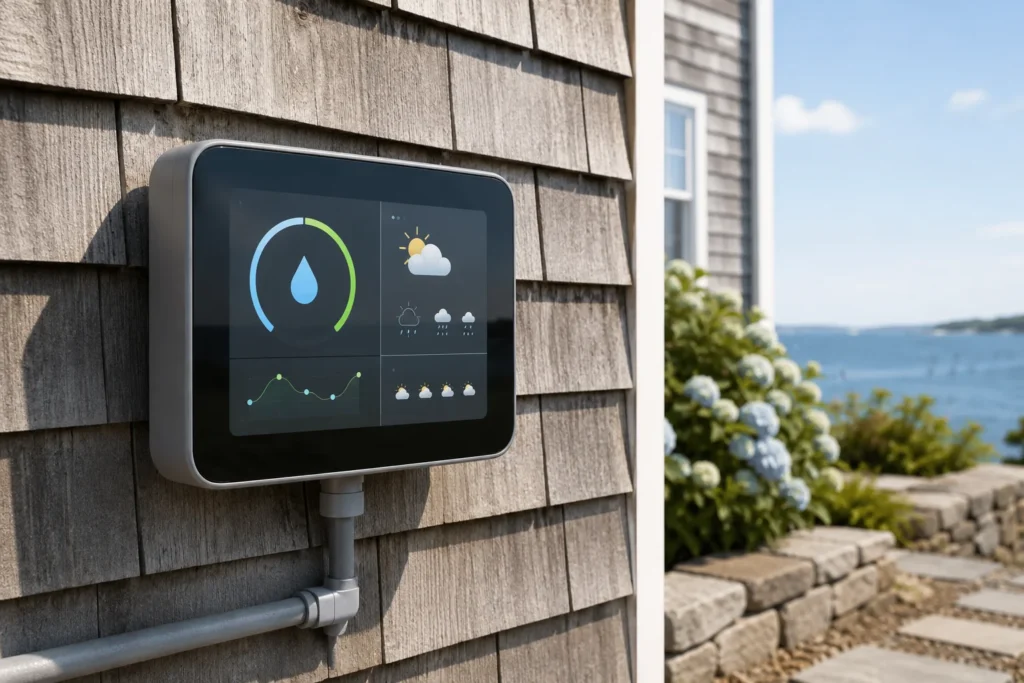
Smart irrigation uses real-time data, either from soil moisture sensors buried in your lawn or from local weather stations, to decide exactly when and how much to water. Instead of running on a fixed timer, the system waters only when your lawn actually needs it.
There are two main types. Soil moisture sensor controllers have sensors placed in the root zone that measure how much water is actually in the ground. According to the University of Florida IFAS Extension, these sensors measure the dielectric constant of the soil, which rises as water content increases, giving the controller an accurate real-time reading. When soil moisture is above a set threshold, the system skips the scheduled cycle automatically. When it drops below, irrigation starts.
Weather-based controllers, also called evapotranspiration or ET controllers, pull data from local weather stations to calculate how much moisture your landscape lost to sun and wind that day. Oklahoma State University Extension describes these as “climate-based controllers” that adjust schedules based on actual atmospheric conditions rather than a preset calendar.
Both types qualify for the EPA WaterSense label when independently certified. According to the EPA, replacing a standard clock-based controller with a WaterSense labeled smart controller can save an average home up to 15,000 gallons of water per year. That’s not a marginal improvement. On a property with an aging timer system, it’s a significant change in both environmental impact and operating cost.
The Hidden Cost of Overwatering on the Vineyard
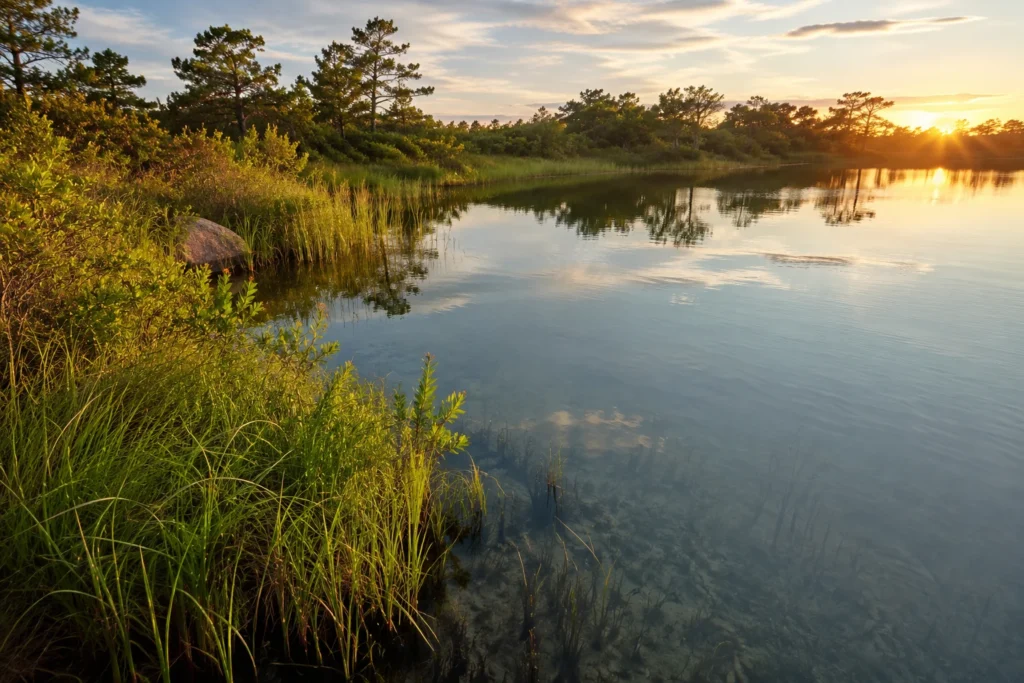
Most Vineyard homeowners think about overwatering in terms of their water bill. That’s a real cost, but the damage runs deeper.
When you over-irrigate sandy soil, water carries dissolved nutrients, particularly nitrogen and phosphorus from fertilizers, straight through the soil profile and into groundwater or nearby waterways. NOAA reports that 65% of studied estuaries and coastal waters in the contiguous United States have experienced eutrophication, a process where excess nutrients trigger algae overgrowth, deplete oxygen levels, and create dead zones that cannot support marine life. On Martha’s Vineyard, where freshwater ponds and coastal estuaries are central to the island’s ecosystem, the connection between your lawn and the water body at the end of your road is very direct.
Overwatering also works against an organic approach. If you’re investing in a NOFA-certified organic lawn program, consistent and measured moisture delivery is what makes that investment perform. As NOFA’s organic land care documentation explains, reliable moisture helps your soil biology thrive. Leaching that moisture away with oversaturation undermines the same soil ecosystem you’ve worked to build, and it sends the nutrients you’ve carefully applied straight past the root zone before they can do any good.
How Does Salt Air Affect Your Irrigation System?
Salt air accelerates corrosion in coastal irrigation systems, attacking metal valve components, wire connections, and exposed fittings far faster than in inland environments. On Martha’s Vineyard, salt-laden wind can compromise irrigation hardware within just a few seasons without proper maintenance.
The mechanism is simple. According to coastal plumbing specialists, moisture from humidity combines with salt to trigger chemical reactions that corrode metal faster than ordinary air. Hose bibs, valve boxes, and exposed wiring are particularly vulnerable. In a system that sits idle through winter and activates again in spring, corroded components can mean uneven coverage, invisible leaks, or complete zone failures that go unnoticed until the lawn starts showing damage.
A properly installed smart irrigation system uses marine-grade or corrosion-resistant components in exposed locations, and our Irrigation Association certified technicians include annual system audits as part of the service program. Those audits matter on the Vineyard, where salt exposure compounds quietly over seasons until a fitting finally gives way.
Smart Irrigation and Organic Lawn Care: Better Together

One of the most practical reasons to pair smart irrigation with an organic lawn program is that both systems depend on the same foundation: a healthy, biologically active soil layer. When one is working well, it makes the other work better.
Aeration and overseeding opens compacted soil to better water penetration, reducing the surface runoff that can happen even on sandy ground during heavy irrigation cycles. Soil testing reveals what your lawn actually needs chemically, so you’re not applying fertilizer that will simply leach away with the next irrigation pass. Smart irrigation then delivers moisture consistently enough that the soil biology, the beneficial bacteria, fungi, and microorganisms that organic programs cultivate, can do their work without drying out between sessions.
The result is a lawn that uses water more efficiently at every level: how the system delivers it, how the soil retains it, and how the grass roots absorb it. You get show-quality turf without the inputs that wash into the pond at the end of the road.
What Does an Estate Care Irrigation Assessment Look Like?
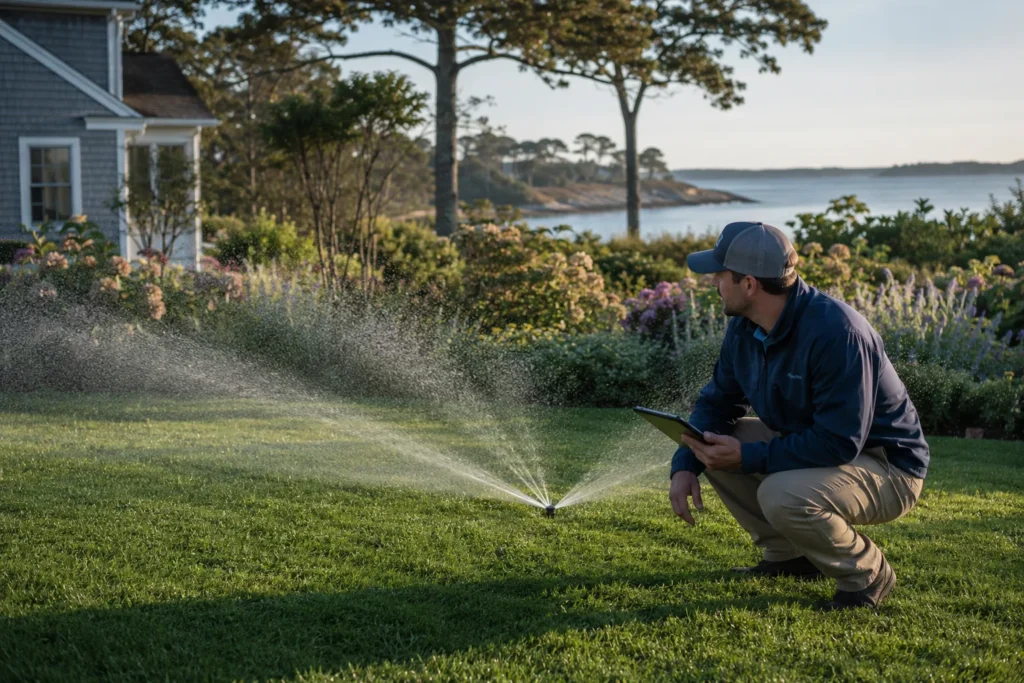
An Estate Care irrigation assessment starts with a zone-by-zone inspection of your existing system, a soil evaluation, and a review of your property’s sun exposure, slope, and plant types. The result is a written report with specific recommendations and, where it makes sense, a proposal for upgrading to a smart controller or adding soil moisture sensors.
Here’s what the process covers. Our Irrigation Association certified technicians inspect each zone for coverage gaps, broken heads, and pressure irregularities. We test run times against the actual water needs of your grass and plant types in each part of the property. We review whether your current schedule accounts for MV’s seasonal drought windows, typically June through August, and whether the system is drawing down resources unnecessarily during the wetter shoulder months.
For properties on full estate management contracts, irrigation monitoring is part of the year-round service. Post-visit reports include system status so off-island owners always know whether irrigation is running correctly and how the lawn is holding through summer heat, without needing to be present to find out.
When Is the Right Time to Install or Upgrade?
Spring, specifically May and early June, is the best window for smart irrigation installation or upgrades on Martha’s Vineyard. By late May, soil temperatures have stabilized enough for accurate sensor calibration, and summer drought conditions typically set in by late June. A system installed in May has time to be tuned and tested before the first real dry stretch arrives.
Installing in summer, when the system needs to be running constantly, means calibration happens under pressure with less margin for adjustment. And on Martha’s Vineyard, contractor availability is a real factor: demand for all property services peaks around Memorial Day weekend. Booking your assessment now puts you ahead of that rush and ensures your system is ready when it matters.
A Smarter Approach to Island Stewardship
Martha’s Vineyard is worth protecting. Its ponds, its beaches, its fragile coastal soil ecosystem, these are the reasons people choose to build a life or a second home here. Smart irrigation is one of those decisions that feels practical (lower water bills, a healthier lawn) and turns out to be genuinely aligned with caring for this place.
According to the EPA, if every home in the United States with an automatic sprinkler system installed and properly operated a WaterSense labeled controller, the country could save up to 390 billion gallons of water annually. On Martha’s Vineyard, where every gallon that leaches away carries nutrients toward the pond system, that math isn’t abstract.
If you’re ready to make the upgrade, or just want to know what your current system is actually doing, book a smart irrigation assessment with Estate Care. We’ll take a full look at your property and put together a tailored plan for your specific conditions, before summer arrives.
Frequently Asked Questions
How much water can a smart irrigation system save on Martha’s Vineyard?
According to the EPA’s WaterSense program, replacing a standard clock-based controller with a certified smart controller saves an average home up to 15,000 gallons of water per year. On Martha’s Vineyard, where sandy soils encourage overwatering and drought conditions are recurring, the actual savings may be higher because timer-based systems tend to run more often than necessary to compensate for fast-draining soil.
Do smart irrigation systems work on sandy, fast-draining soil?
Yes, and they’re especially well suited to it. Smart soil moisture sensors are placed in the root zone and measure actual water content in the ground. Because sandy soil drains quickly, a standard timer can run a full cycle that moves past the roots before the grass uses it. A soil moisture sensor stops the cycle when the root zone is adequately saturated, preventing the overwatering that sandy soil otherwise invites. Short, more frequent cycles scheduled by a smart system are significantly more effective than long, infrequent ones on Vineyard soils.
Will salt air damage my irrigation system over time?
It can, yes. Salt air accelerates corrosion in metal valve components, exposed wiring, and fittings, often causing failures within a few seasons if materials aren’t specified correctly for coastal environments. A professional system installed by Irrigation Association certified technicians uses corrosion-resistant or marine-grade components in exposed locations, and includes annual inspections to catch hardware deterioration before it causes zone failures or undetected leaks.
Can I add smart controls to my existing sprinkler system?
In most cases, yes. Smart controllers are designed to work with standard multi-zone irrigation systems. An Estate Care assessment will confirm whether your existing wiring, valve setup, and zone layout are compatible, and what upgrade path makes sense for your property’s size and soil conditions. Full replacement is sometimes more cost-effective than retrofitting older systems, especially those with significant salt-air corrosion.
How often does a smart irrigation system need maintenance on the Vineyard?
An annual spring startup inspection and a fall winterization visit are the baseline for any irrigation system on Martha’s Vineyard. For smart systems, the spring visit also includes controller calibration, sensor testing, and a schedule review based on current drought conditions and the coming season’s forecast. Properties on Estate Care’s full management program receive irrigation status updates in every post-visit report, so the system is monitored continuously rather than checked twice a year.



Questions About Your Property?
Our team is always happy to talk through your specific situation - no commitment required.