

Fall Lawn Care on Martha’s Vineyard: August–November Checklist for a Healthier Spring Lawn
TL;DR: Fall is the most important recovery season for many Martha’s Vineyard lawns. Start by assessing summer damage in late August, then use the late-August-to-mid-September window for lawn renovation and overseeding when needed. Aerate compacted areas, base fertilization on actual soil needs, keep new seed consistently moist, continue mowing while the grass is actively growing, and never allow a heavy layer of leaves to sit on the turf. By November, the goal is simple: a clean, properly mowed lawn with healthy roots and as little unresolved stress as possible heading into winter.
For a beautiful lawn next May, the work often starts in August.
Summer on Martha’s Vineyard is demanding on turf. Heat, periods of drought, irrigation problems, foot traffic, outdoor entertaining and routine mowing all accumulate over the busiest months of the year. By late August, lawns that looked perfect in June may have thin areas, compacted zones, brown patches or places where weeds have taken advantage of stressed grass.
The good news is that fall gives cool-season turf an opportunity to recover.
According to UMass Extension’s lawn renovation and overseeding guidance, late summer and early fall provide one of the strongest periods for turf establishment in Massachusetts. For lawn renovation specifically, approximately August 15 through September 15 generally offers an excellent combination of warm soil, cooler air and lower annual weed pressure.
On Martha’s Vineyard, coastal conditions can sometimes allow that establishment window to extend slightly later, but waiting too long still reduces the time young turf has to develop before winter.
Successful fall lawn care is therefore not one treatment performed on one weekend.
It is a sequence.
Here is how homeowners should approach that sequence on Martha’s Vineyard from late August through November.
Why Is Fall So Important for Martha’s Vineyard Lawns?
Most residential lawns on Martha’s Vineyard rely heavily on cool-season turfgrasses.
Unlike warm-season grasses, cool-season turf performs strongly during the milder temperatures of spring and fall. Once the most intense summer heat begins to fade, the lawn has an opportunity to recover, develop new growth and strengthen its root system before winter.
That makes fall more than a cleanup season.
It is a recovery and preparation season.
A properly managed lawn can use this period to:
- recover from summer heat and drought stress;
- fill thin or bare areas;
- develop stronger roots;
- improve turf density before winter;
- correct certain soil problems;
- reduce opportunities for weeds;
- enter winter dormancy in better condition.
The timing is particularly important on Martha’s Vineyard because no two properties experience summer in exactly the same way.
An open coastal lawn exposed to wind and salt spray can finish August very differently from a shaded property beneath mature trees. A heavily used seasonal home may show compaction around patios, walkways and gathering areas, while another lawn may simply be recovering from irrigation limitations or extended dry weather.
That is why the first step in a professional Martha’s Vineyard lawn care program is not automatically aerating, fertilizing or seeding.
The first step is figuring out what happened.
Late August: Start With a Full Lawn Assessment
Before beginning fall treatments, walk the entire lawn.
Do not inspect it from the driveway.
Look closely enough to distinguish between a lawn that simply slowed down during summer and one with a problem that requires intervention.
Pay particular attention to:
- thin turf;
- bare soil;
- compacted high-traffic areas;
- brown or dormant sections;
- weeds moving into weak turf;
- areas where irrigation coverage appears inconsistent;
- excessive thatch;
- drainage problems;
- disease symptoms;
- sections that perform noticeably differently from the rest of the property.
A brown lawn is also not automatically a dead lawn.
Cool-season grass that has entered normal summer dormancy can begin recovering when adequate moisture and milder temperatures return. Giving turf time to respond can prevent unnecessary renovation.
For lawns with widespread thinning, bare areas or more serious summer damage, a professional assessment can help determine whether the property needs simple overseeding or a more complete lawn aeration and overseeding program.
Estate Care Field Note
One of the most common fall mistakes we see is treating an entire Vineyard property as though every section has the same problem.
It rarely does.
A sunny front lawn, a shaded area under mature oaks and a salt-exposed coastal edge may need three different responses even though they are part of the same property.
The better approach is to divide the lawn into management zones and treat what each zone actually needs.
Should You Test the Soil Before Fall Lawn Treatments?
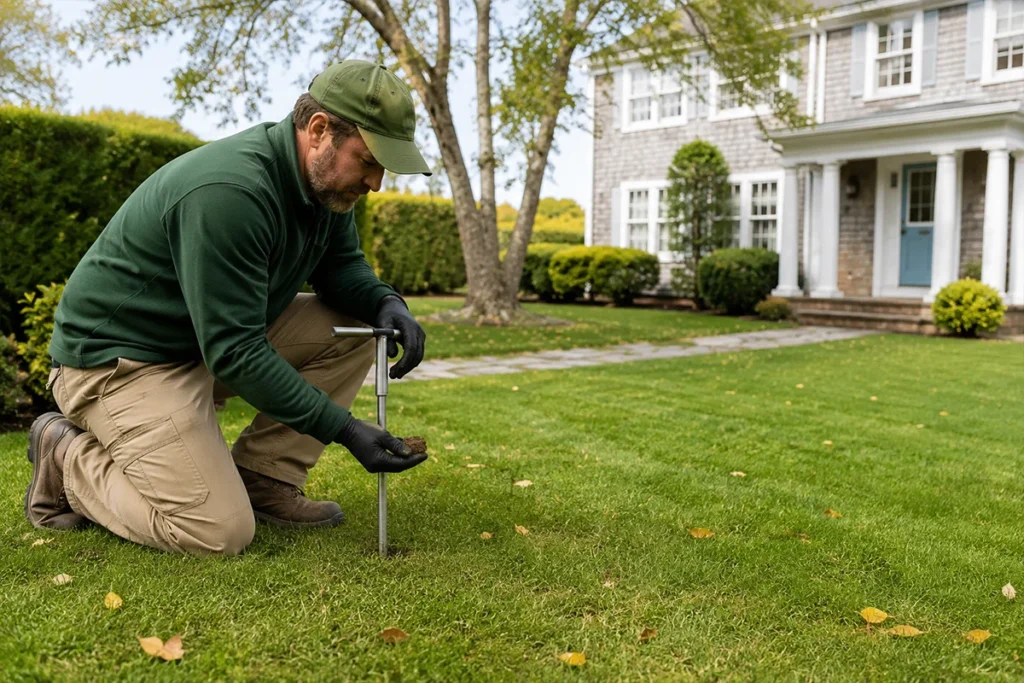
If your lawn has recurring problems, unexplained thinning, poor color or a history of fertilization without soil testing, fall is an excellent time to stop guessing.
A professional soil test and lawn fertility analysis can help identify pH conditions and nutrient deficiencies before amendments are selected.
This matters for plant health, but it also prevents unnecessary nutrient applications.
Massachusetts regulates nutrient applications to lawns, including restrictions on phosphorus-containing fertilizer. The state’s Plant Nutrient Management guidance explains that phosphorus use on established non-agricultural turf is restricted unless conditions such as an appropriate soil test justify its application.
That is especially relevant on Martha’s Vineyard.
Our ponds, groundwater and coastal waters are sensitive to excess nutrient loading. Applying fertilizer simply because the lawn looks weak can waste money while doing nothing to correct the underlying problem.
If you do not know what is happening below the turf, soil testing should come before corrective fertilization.
Late August Through Mid-September: Is It Time to Aerate and Overseed?
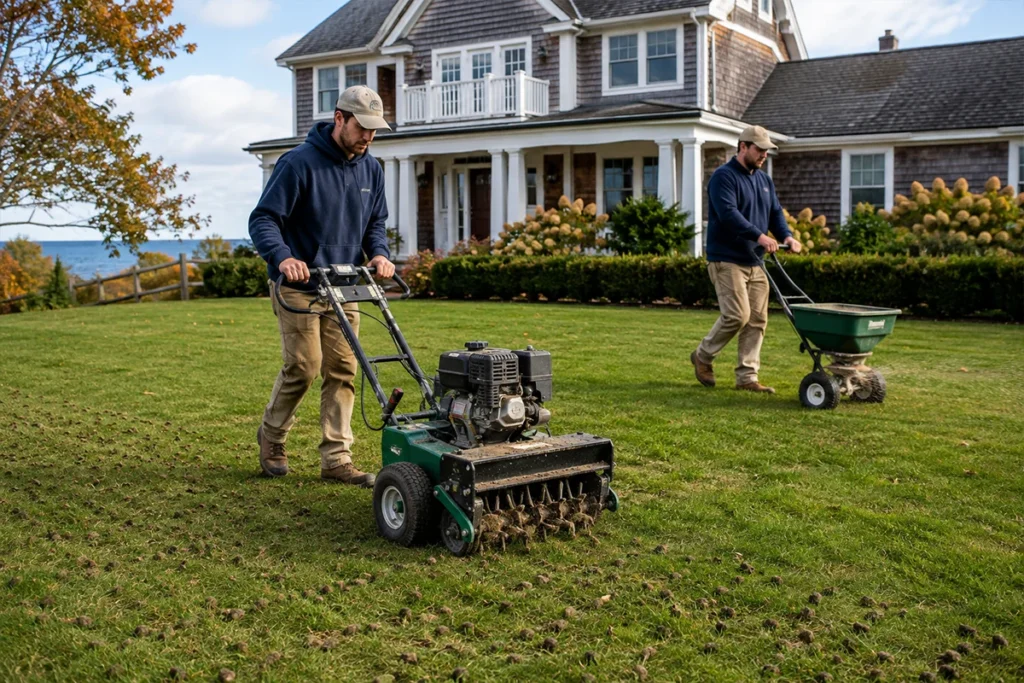
For lawns that are compacted, thin or worn from summer use, this is one of the most valuable windows of the entire year.
UMass Extension recommends late summer into early fall for lawn renovation, with roughly August 15 through September 15 generally producing excellent results because the soil remains warm enough for germination while air temperatures become less stressful for developing turf.
Core Aeration
Core aeration mechanically removes small plugs of soil from the lawn.
Its purpose is not simply to create holes in the turf.
When used correctly, core aeration can help relieve soil compaction and improve the movement of air, water and nutrients through the root zone.
It can be particularly valuable on areas that experienced heavy summer foot traffic, mower traffic or repeated use around patios, pools and outdoor living areas.
Aeration also creates better conditions for overseeding because it increases opportunities for grass seed to reach the soil.
But aeration should solve a problem.
A lawn that is already loose, healthy and well-drained does not automatically need to be aerated just because September has arrived.
Overseeding
Overseeding introduces new grass seed into an existing lawn instead of removing the entire lawn and starting again.
It is particularly useful where summer stress has left the turf thin but enough healthy grass remains to justify renovation rather than complete replacement.
The critical factor is seed-to-soil contact.
Seed sitting on top of dense existing grass or a heavy thatch layer has a much lower chance of establishing successfully. UMass Extension’s Best Management Practices for Lawn Establishment, Renovation and Repair recommends creating adequate surface disruption so new seed can reach the soil.
Aeration, dethatching, topdressing and slice seeding can all help improve seed-to-soil contact when used appropriately.
Timing matters just as much as technique.
The later seeding is pushed into fall, the less time seedlings have to mature before winter.
UMass notes in its late-season turf establishment guidance that warmer areas such as Cape Cod, the Islands and coastal southeastern Massachusetts can sometimes extend the establishment window slightly later than inland regions.
That extra flexibility should not be confused with unlimited time.
The practical lesson for Vineyard homeowners is simple: do not wait until heavy leaf fall to begin thinking about overseeding.
By then, much of the strongest renovation window has already passed.
September: How Should You Water Newly Overseeded Areas?
Existing mature turf and newly seeded turf have very different moisture requirements.
Established grass generally benefits from deeper, less frequent irrigation that encourages deeper rooting.
Newly germinating seed is different.
The upper layer of the seedbed needs to remain adequately moist during germination and early establishment. Allowing young seed to repeatedly dry out can significantly reduce establishment.
That means the irrigation schedule may temporarily need to change in freshly overseeded areas.
Once seedlings establish, irrigation can gradually transition toward deeper and less frequent watering.
For larger properties or lawns with different sun, soil and exposure zones, a properly configured smart irrigation system can make this transition easier by delivering water according to actual site conditions rather than relying on one fixed schedule for the entire property.
Do Not Leave the Irrigation Controller on a July Schedule
Fall brings lower temperatures, shorter days and generally lower water demand than peak summer.
Continuing an aggressive midsummer irrigation schedule into fall can oversaturate parts of the lawn, waste water and potentially create conditions that favor turf disease.
Adjust irrigation as temperatures, rainfall and turf growth change.
Good irrigation responds to the landscape.
It does not respond to the calendar alone.
Should You Fertilize the Lawn in Fall?
Fall can be an important nutrient-management period for cool-season grass, but that does not mean every lawn needs the same fertilizer.
According to UMass Extension’s Soil & Nutrient Management guidelines, the late-August to early-September period around Labor Day is particularly important for cool-season turf nutrition because appropriate nitrogen availability can support recovery from summer stress and fall growth.
The key word is appropriate.
Not excessive.
Do not fertilize a drought-dormant or severely stressed lawn simply because the calendar says September.
First restore normal growing conditions. Then determine what the turf actually needs.
A soil-based fertility program can identify nutrient conditions and help prevent unnecessary applications.
Phosphorus should never be treated as an automatic part of lawn fertilization. Massachusetts nutrient-management regulations restrict phosphorus applications to established lawns except under qualifying conditions such as demonstrated need through soil testing.
Homeowners who want to minimize synthetic inputs can also consider a professionally designed organic lawn care program focused on soil health and long-term turf resilience.
A stronger fall lawn comes from better nutrient decisions, not simply more fertilizer.
October: Should You Keep Mowing Your Lawn?
Yes.
One of the most common fall lawn-care myths is that mowing should stop as soon as summer ends.
Grass does not follow the tourist season.
If the lawn is actively growing, continue mowing it.
UMass Extension’s lawn mowing guidance recommends following the one-third rule: avoid removing more than approximately one-third of the existing grass shoot growth during a single mowing.
This reduces unnecessary stress on the turf.
Mowing frequency should therefore be determined by growth, not by a fixed number of days.
During periods of fast growth, mowing may remain relatively frequent. As soil and air temperatures fall and growth slows, the interval between cuts naturally becomes longer.
What you should avoid is suddenly scalping the lawn during the final cut.
If mowing height needs to be reduced later in the season, bring it down gradually rather than removing a large portion of the blade at once.
Continue mowing into fall while the turf is actively growing.
What Should You Do With Fallen Leaves?
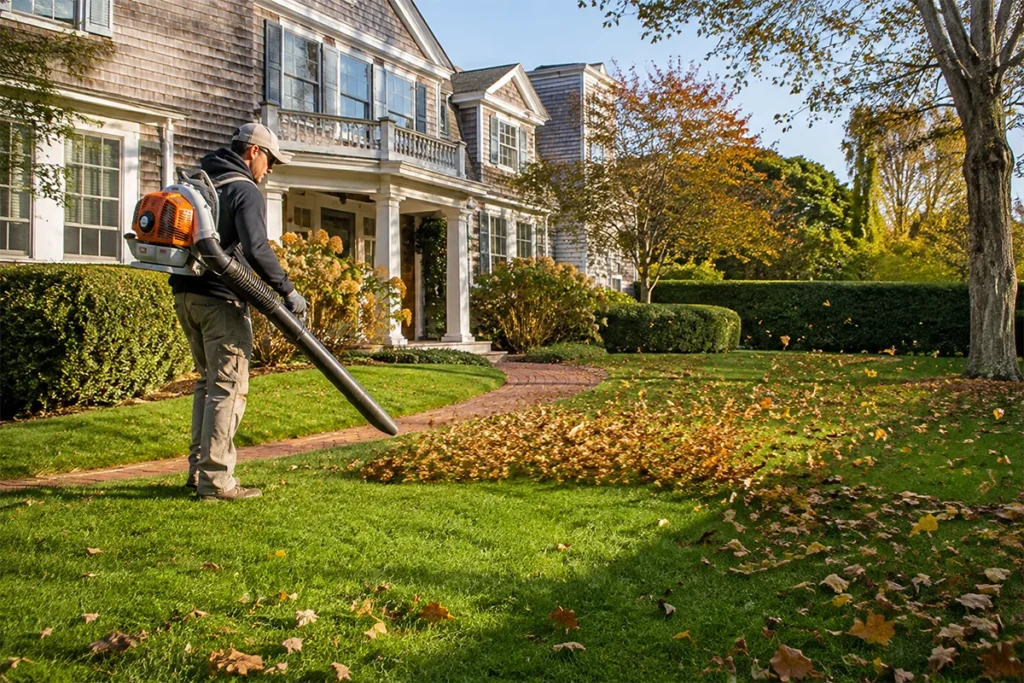
Do not allow a thick layer of leaves to remain on the lawn for an extended period.
Cool-season turf is still photosynthesizing and preparing for winter during fall. Heavy leaf accumulation blocks sunlight and can create thin or bare turf where dense layers remain too long.
That does not mean every individual leaf needs to be removed from the property.
When leaf coverage is moderate, mowing dry leaves into smaller pieces can be an effective approach.
UMass Extension’s guidance on yard waste and leaf management explains that moderate amounts of leaves can be mulched directly into turf when the material is finely chopped.
The important distinction is volume.
A light layer of shredded dry leaves is very different from several inches of wet oak leaves forming a dense mat over the grass.
For larger Vineyard properties with mature tree canopy, waiting until every leaf has dropped before beginning cleanup often creates more work and leaves the turf covered for too long.
Multiple lighter cleanups throughout autumn are frequently better than one massive cleanup at the end of the season.
For properties with substantial tree cover or seasonal homeowners leaving the Island before leaf drop is complete, Estate Care provides professional fall and seasonal cleanup services throughout Martha’s Vineyard.
October Into November: What About Areas That Are Still Thin?
By this point, timing becomes increasingly important.
If small areas need minor repair and weather remains favorable, some establishment may still be possible — particularly given Martha’s Vineyard’s relatively mild coastal conditions.
But October is not the ideal time to begin a major lawn renovation simply because the summer season is finally over.
The UMass late-season establishment guidance notes that the optimal seeding period normally occurs from approximately the third week of August through the third week of September, with coastal southeastern Massachusetts and the Islands sometimes able to extend slightly beyond that range.
As the season advances, establishment becomes progressively less predictable.
Instead of forcing a late renovation:
document the problem, protect exposed soil where necessary and build the repair into the next appropriate treatment window.
Good lawn management also means knowing when not to intervene.
November: What Does the Final Fall Lawn Checklist Look Like?
By late fall, the goal changes.
You are no longer trying to push rapid visible growth.
You are preparing the property to enter winter cleanly and with as few unresolved problems as possible.
Before the season closes, check that:
- Heavy leaf accumulation has been removed or appropriately mulched.
- The lawn has received its final mowing after growth has substantially slowed.
- No heavy piles of grass clippings, leaves or debris are sitting on the turf.
- Irrigation has been adjusted and properly winterized when appropriate.
- Drainage problems have been identified before winter weather makes them harder to diagnose.
- Newly established turf is progressing normally.
- Areas requiring future work have been documented.
- Lawn edges, beds and surrounding landscape areas are clean enough that spring does not begin with unfinished fall work.
For seasonal properties, this is also the right moment for a broader property inspection.
A lawn can be prepared perfectly while clogged drainage, fallen branches, unsecured outdoor furniture, irrigation problems or storm-related issues create entirely different winter risks.
That is why fall lawn care often works best as part of a broader complete property care program, particularly for homeowners who spend the winter off-Island.
Martha’s Vineyard Fall Lawn Care Calendar
| Period | Main Goal | Priority Work |
|---|---|---|
| Late August | Diagnose summer stress | Inspect thin and bare areas, evaluate irrigation, check compaction and test soil where needed |
| Late August–Mid September | Repair and establish turf | Core aeration where appropriate, overseeding and lawn renovation |
| September | Support recovery | Maintain seed moisture, monitor germination and apply nutrients only when justified |
| October | Maintain healthy growth | Continue mowing, manage leaves regularly and monitor renovated areas |
| Late October–November | Prepare for winter | Final mowing, leaf cleanup, irrigation winterization and final property inspection |
The exact timing can shift from year to year.
Weather, soil moisture, exposure, turf species and the property’s location on the Island all matter.
That is why a calendar should guide the work — not replace observation.
What Fall Lawn Care Mistakes Should You Avoid?
Waiting Too Long to Overseed
Homeowners often associate fall lawn work with October leaves.
For seeding, that is usually too late to begin planning.
The strongest renovation window starts while much of Martha’s Vineyard still looks like summer.
Fertilizing a Stressed or Dormant Lawn
Fertilizer cannot compensate for lack of water or severe summer stress.
Restore normal growing conditions first, then determine what nutrients are actually required.
Aerating Every Lawn Automatically
Core aeration is an excellent tool when soil compaction or renovation justifies it.
It is not a mandatory annual ritual for every square foot of turf.
Ignoring Irrigation After Overseeding
Seeding is not finished when the spreader leaves the lawn.
The establishment period that follows is just as important as the application itself.
Letting Leaves Sit for Weeks
A clean lawn is not only about appearance.
Heavy accumulated leaves prevent light from reaching actively growing turf and can leave thin areas behind.
Scalping During the Final Mow
The final mowing is not an excuse to remove half the grass blade in one pass.
Continue following proper mowing practices until turf growth has largely stopped.
Can You Handle Fall Lawn Care Yourself?
Absolutely — especially if your lawn is already healthy and you are on the Island often enough to monitor it.
A homeowner with the right equipment and knowledge can handle routine mowing, moderate leaf management, small repairs and basic irrigation adjustments.
Professional help becomes more valuable when:
- the property contains several lawn zones with different problems;
- you are dealing with widespread thinning or summer damage;
- significant soil compaction needs to be corrected;
- large areas require overseeding;
- you need professional soil testing and a nutrient plan;
- irrigation coverage is inconsistent;
- the property is large or complex;
- you are leaving Martha’s Vineyard before fall work is finished.
For seasonal homeowners, the last point is particularly important.
Much of the Vineyard’s most useful turf-recovery period happens around the same time many seasonal residents begin spending less time on the Island.
The lawn does not stop needing attention when you leave.
Prepare Your Lawn in Fall, Not Next Spring
The best spring lawn is usually not created in spring.
It is created by the decisions made during the previous August, September, October and November.
Assess summer damage before treating it.
Use the late-summer renovation window instead of waiting for cold weather.
Aerate where compaction justifies it.
Overseed early enough for new turf to establish.
Base fertilization on actual soil needs.
Keep mowing while the grass is growing.
Keep heavy leaves off the lawn.
Most importantly, treat your property as a specific site rather than following a generic national lawn-care calendar.
Martha’s Vineyard has too much variation in soil, salt exposure, shade, wind and seasonal use for one formula to work everywhere.
If you are already planning ahead, our Spring Lawn Care on Martha’s Vineyard checklist explains how the work you do now connects to the next growing season.
At Estate Care, we build custom lawn care programs for Martha’s Vineyard properties around the actual condition of each lawn, including soil testing, lawn restoration, core aeration and overseeding, fertility management, precision mowing, irrigation and seasonal cleanup.
We serve properties throughout Edgartown, Oak Bluffs, Vineyard Haven, West Tisbury, Chilmark and Aquinnah.
If you want your lawn evaluated before the fall renovation window closes, contact Estate Care for a free consultation and estimate or call (508) 560-8186.
Frequently Asked Questions
When is the best time for fall lawn care on Martha’s Vineyard?
Fall lawn preparation begins in late August, not October. For renovation and overseeding, UMass Extension identifies roughly August 15 through September 15 as the preferred late-summer window for much of Massachusetts. Maintenance such as mowing and leaf management then continues through October and into November as conditions require.
When should I aerate and overseed my lawn on Martha’s Vineyard?
Late August through mid-September is generally the strongest window when renovation is required. Core aeration and overseeding are particularly useful when turf is thin and soil compaction is limiting root development. Exact timing should still reflect soil moisture, weather and the condition of the lawn.
Is October too late to overseed a lawn in Massachusetts?
For major renovations, October carries substantially more risk. UMass recommends avoiding large new seed-establishment projects after the end of September when possible because seedlings may not establish adequate cover before winter.
Should I fertilize my lawn in the fall?
Fall can be an important fertility period for cool-season turf, particularly in late August and early September. That does not mean every lawn needs the same fertilizer. A soil test should guide nutrient decisions, and Massachusetts restrictions on phosphorus-containing lawn fertilizer must be followed.
Should I remove all leaves from my lawn?
Not necessarily. Moderate amounts of dry leaves can often be finely mulched into turf. Heavy accumulation should be removed because dense leaf cover prevents light from reaching the grass and can contribute to thin or bare areas. Large properties with mature tree canopy often benefit from several seasonal cleanups instead of one late cleanup.
When should I stop mowing my lawn in fall?
Continue mowing while the grass is actively growing. Do not stop simply because the calendar reaches October. UMass recommends mowing through late autumn as needed and avoiding removal of more than one-third of the grass blade in a single cut.
Related Articles.

Jul 9, 2026
Lawn Care in Aquinnah, Martha’s Vineyard: Stewardship at the Island’s Most Dramatic Edge

May 25, 2026
Lawn Care Edgartown Martha’s Vineyard: A Property Owner’s Guide to the Island’s Most Storied Town

Dec 27, 2025
Organic lawn care for sandy soil – science for lush results
Questions About Your Property?
Our team is always happy to talk through your specific situation - no commitment required.